
Military Story of the Week: Sgt. 1st Class Alwyn C. Cashe: Duty Beyond the Flames
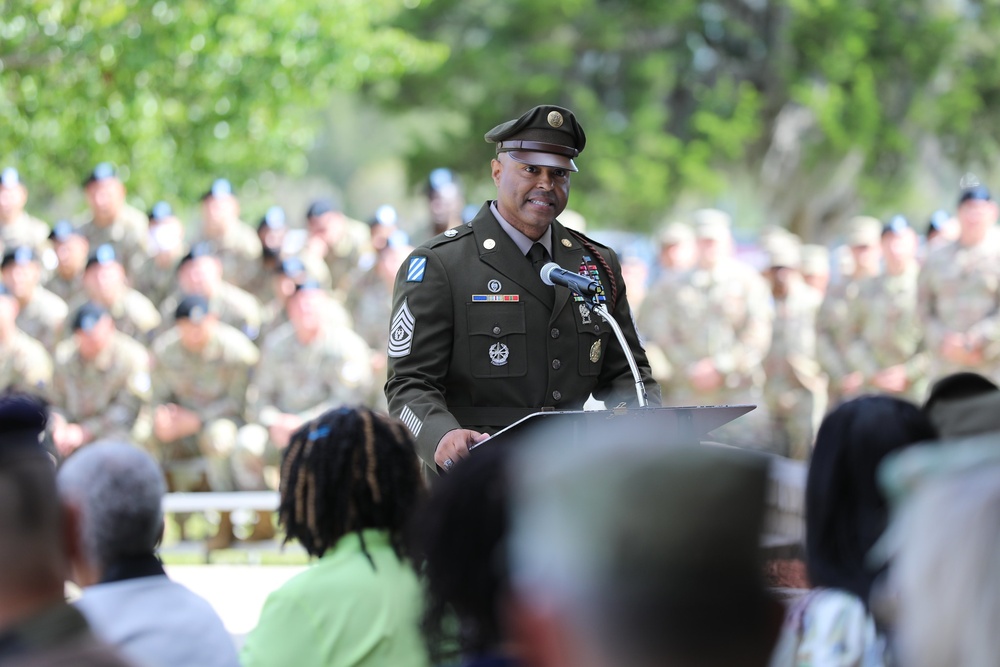
"U.S. Army photo by Lt. Col. Lindsey Elder, 3rd Infantry Division. Cashe Garden dedication, Fort Stewart, Georgia, May 20, 2021. DVIDS Photo ID 6976497."
"This work, A Dogface Soldier through and through: Memories of SFC Alwyn Cashe, by LTC Lindsey Elder, identified by DVIDS, must comply with the restrictions shown on https://www.dvidshub.net/about/copyright."
The appearance of U.S. Department of War (DoW) visual information does not imply or constitute DoW endorsement.
Web Preview
On Oct. 17, 2005, Sgt. 1st Class Alwyn C. Cashe was serving as a platoon sergeant with Company A, 1st Battalion, 15th Infantry Regiment, 3rd Infantry Division, in Iraq’s Salah Ad Din Province. When an improvised explosive device struck his Bradley Fighting Vehicle and ignited its fuel, Cashe faced a decision measured in seconds.
Though severely burned, he repeatedly entered the burning vehicle to rescue six soldiers and an Iraqi interpreter. He continued helping his soldiers even after his own uniform had caught fire and his injuries had become life-threatening. Cashe refused medical evacuation until the soldiers under his care had been treated.
He died on Nov. 8, 2005. Sixteen years later, his Silver Star was posthumously upgraded to the Medal of Honor and presented to his widow, Tamara Cashe, at the White House. Sgt. 1st Class Cashe’s story is not only one of extraordinary courage. It is a lasting example of leadership rooted in duty, sacrifice, and love for the people entrusted to your care.
Full Feature: A Leader Who Went Back
Military history often remembers the sound of battle: the blast, the alarms, the commands, and the movement of people responding under pressure. But the deepest meaning of service is often found in what one person chooses to do when fear, injury, and instinct all point in the opposite direction.
For Sgt. 1st Class Alwyn C. Cashe, that choice came on Oct. 17, 2005.
Cashe was serving as a platoon sergeant with Company A, 1st Battalion, 15th Infantry Regiment, 3rd Infantry Division, in Salah Ad Din Province, Iraq. During a mission, an improvised explosive device struck the Bradley Fighting Vehicle carrying soldiers and an Iraqi interpreter. The blast ignited the vehicle’s fuel, turning the interior into a fire-filled emergency.
Cashe was badly injured almost immediately. His clothing was soaked with burning fuel, and he suffered severe burns over much of his body. Yet his first concern was not his own evacuation. It was the soldiers inside the vehicle.
He went back.
Then he went back again.
Despite his injuries, Cashe repeatedly entered the burning Bradley to pull out six soldiers and the Iraqi interpreter. He moved through flames and smoke to reach people who could not safely escape on their own. Each return exposed him to greater danger, but each return also gave another person a chance to live.
This was not a single dramatic act separated from the rest of his service. It was the clearest expression of the responsibility he had carried as a platoon sergeant. His soldiers depended on him for direction, protection, and steadiness. In the most dangerous moment of his life, Cashe continued to see them as his responsibility.
Accounts of the incident describe Cashe refusing medical evacuation until the soldiers he was leading had received care. His decision reflected a principle familiar to generations of military leaders: the welfare of the team comes before personal comfort, recognition, or safety.
That principle does not make sacrifice easy. It makes the choice clear.
The soldiers rescued from the Bradley suffered serious injuries. Cashe was transported for treatment, but his wounds were ultimately fatal. He died on Nov. 8, 2005, leaving behind his wife, Tamara, his family, and the soldiers and friends who remembered him as a leader who cared deeply for the people around him.
For years, those who knew Cashe worked to ensure that the full measure of his actions was recognized. He had initially received the Silver Star for his valor. In 2021, Congress approved a waiver allowing the time limit for the Medal of Honor to be set aside, clearing the way for the award to be upgraded.
On Dec. 16, 2021, President Joseph R. Biden Jr. presented the Medal of Honor to Tamara Cashe at the White House. The ceremony also recognized two other soldiers, Master Sgt. Earl D. Plumlee and Sgt. 1st Class Christopher A. Celiz. Cashe became the first Black service member to receive the Medal of Honor for service during the Iraq and Afghanistan-era conflicts.
The ceremony brought national recognition to an act that had already been known intimately by those who served with him. The medal did not create Cashe’s legacy. It formally recorded what his soldiers had already understood: when the moment came, he put their lives ahead of his own.
Duty, Sacrifice, and the Meaning of Leadership
Sgt. 1st Class Cashe’s story is sometimes described through the physical danger of the rescue. That danger should not be minimized. He suffered devastating injuries while returning to a burning vehicle. But the significance of his actions reaches beyond the flames.
Cashe understood leadership as presence.
He did not direct others from a distance and withdraw from the danger himself. He entered the same environment his soldiers faced. He shared their risk. He stayed with them until the immediate responsibility of getting them to care had been met.
That kind of leadership is built before a crisis. It grows through daily discipline, trust, preparation, and personal investment in the people who serve alongside you. When the crisis arrives, those habits become action.
The official U.S. Army Medal of Honor record preserves the details of Cashe’s courage. The Army’s remembrance of his life and service also helps show the person behind the citation: a Dogface Soldier, a platoon sergeant, a husband, a friend, and a leader remembered by those who served with him.
His legacy is not a call to seek danger. It is a reminder to accept responsibility when others depend on us. In military service, in public service, and in ordinary life, leadership is revealed by what we do for the people placed in our care.
Remembering Without Turning Away
There is a temptation when telling stories of military valor to focus only on the extraordinary moment. Cashe’s story deserves more than that. His sacrifice should be remembered with clarity, not spectacle; with respect, not pity.
He was a professional soldier who knew his mission and understood his obligation to his team. He was also a Black American service member whose recognition came after years of advocacy and whose Medal of Honor helped correct a long-standing gap in the nation’s public acknowledgment of valor during the Iraq and Afghanistan era.
The medal presented to Tamara Cashe honored Alwyn’s actions, but it also acknowledged the enduring cost carried by families, fellow soldiers, and communities after a service member gives everything.
Sgt. 1st Class Alwyn C. Cashe’s story endures because it shows duty in its most personal form. He saw soldiers in danger and went toward them. He remained focused on their care even while his own life was slipping away.
That is duty beyond the flames.
A Separate Note from Office Furniture Express
Office Furniture Express is a Black-owned, veteran-owned small business. We hold Service-Disabled Veteran-Owned Small Business (SDVOSB), California Disabled Veteran Business Enterprise (DVBE), and Small Business/Micro-Business (SB-Micro) certifications, including our California certification numbers, which we provide on request for solicitations that require them. Our DBE status is currently listed as “DBE (re-evaluation in progress)”; no DBE number is stated here.
These credentials are provided to help eligible federal, state, local, and educational buyers evaluate potential procurement paths. Purchases may support applicable agency goals or eligibility, depending on the agency, solicitation, contract scope, purchasing authority, and current program requirements. They are never a guarantee of an award, preference, set-aside, savings, or eligibility.
Office Furniture Express is not an agency, department, or instrumentality of the U.S. Government, the U.S. Department of War (DoW), or any military branch. The appearance of U.S. Department of War (DoW) visual information does not imply or constitute DoW endorsement. Military references in this article are used solely to honor service and describe veteran heritage.
For office furniture requirements, buyers can review our capabilities, browse available solutions through the OFE shop, add products or services to a request list, and select Submit request to begin a conversation about scope, delivery, installation, reconfiguration, and pricing. Government buyers can also review the government buyers portal and consult their contracting or procurement officer regarding applicable procedures.
Continue the Conversation
To discuss desks, workstations, seating, storage, meeting spaces, delivery, certified installation, or office reconfiguration, visit ofexpresspro.com or call (619) 853-7567.
For future stories and company updates, visit the Office Furniture Express blog.